Showing posts with label environment. Show all posts

Sunday, 5 May 2013

Twisted Tradition Project

This is the final stage of a project I have been working on for the last few months. It is based around the ideas behind the Slow Fashion movement promoting the use of environmentally friendly fabrics, ethical manufacturing and lower levels of consumption.

Below are the flat drawing boards and a few illustrations of the collection I have designed which is aimed at men between 30 and 50 incorporating punchy colours, tradition fabrics, reflective tape 9 for the avid cyclist) and detachable elements to make  garments multi-functional and trans-seasonal.

I would really appreciate any feedback you can give me on my work.


Flat Drawing Board


Illustrations


Flat Drawing Board


Wednesday, 24 April 2013

Can I kick my fast fashion habit?


As you've probably gathered from my recent blog posts my work this semester has focused a lot on sustainability within the fashion industry. It is a subject I have been interested in for a while but learning more about the reality of how and where our clothes are made has really made me want to change the way I shop for the better.

The fashion industry uses huge amounts of resources: water, energy, chemicals, oil, the list goes on, but it is also responsible for terrible pollution from the use of pesticides and dyes as well as the exploitation of workers around the world.

Water Pollution caused by textile dying
 http://we.thinkaboutit.eu/profiles/blogs/nightmare-maritsa-river-with


We all know that Primark is bad but the reality is many of the high street chains people perceive as offering better quality and ethics don't, Zara for example, despite charging much more for their products were recently at the heart of a scandal involving the use of slave labour in their factories.  As consumers we have very little concept of where our clothes come from or how they are made and what I have realised from my research is that often companies don't know either due to the complex supply chains in the fashion industry.


3% of Hong Kong's daily textile waste


I am as guilty as anyone of shopping and not thinking about what it is I am buying, what its made from and who they are made by but I've decided that I need to change my shopping habits.
There are a lot of ways to wear more sustainable clothes, the most obvious one is to buy less and wear what you already have. If you think about the amount of energy, resources and time that goes into each garment you own it makes no sense to leave half of them in the back of your wardrobe and then throw them straight into landfill.


Another way to be more sustainable is to buy from charity and vintage shops. Reusing clothes means your are consuming less virgin materials and  making use of what has already been produced. Another great idea is upcycling, either by adapting your old clothes or buying from companies that remake second hand clothes. A brand I really admire are Goodone who produce beautiful clothes from second hand clothes and industrial waste fabric, the designs are really modern and wearable, breaking the stereotype of what 'ethical' fashion looks like.


Goodone AW 2012 collection


There are a lot of companies out there that are doing a lot to improve how sustainable they are, one of the aspects of this is improving the tractability of products so consumers know where their clothes have come from. Nurmi are a band that really focus on this element of their business producing garments that not only are low impact but can be traced back to their source. I really love their jeans which are made from hemp and organic cotton and produced in Finland.


Nurmi Jeans

Unfortunately buying sustainable fashion is more expensive than high street clothing and in reality a lot of people will choose the £2 Primark T-Shirt over the more expensive organic cotton, ethically sourced version. But on the other hand by cutting back on the impulse buys in the Topshop sale you will save money allowing you to invest in better quality clothing that doesn't cost the earth, that's my plan anyway!

Thursday, 11 April 2013

Slow Fashion Project Designs

This week I've been working on my initial designs for my current design project which centres around the idea of sustainability and creating fashion that looks good but is also good for the environment and the people that make it.

I am going to design a menswear capsule collection with the focus on creating garments that can be worn in a number of ways either with detachable or reversible elements.


This first design is for a green herringbone tweed jacket with a detachable wool lining, this makes the garment suitable for both autumn and winter meaning it is very versatile.


The next design is a pair of drop crotch jeans made from 100% hemp denim, the trousers have knee patches, the knees of trousers often get worn so protecting these areas will allow the garment to last longer.


This design is a reversible cashmere coat, the fabric it is made from is double sided so the garment is multifunctional allowing the consumer to get more use from it.


The final image is two shirt designs, both designs have detachable sleeves meaning they can be worn in different ways making them suitable for multiple seasons.

Sunday, 7 April 2013

Fabric shopping at Cloth House


Last week I went to London to visit some of my favourite fabric shops, it sounds sad but its pretty exciting walking in not knowing what you are going to find and slowly bringing a collection to life. My favourite street to shop for fabric is Berwick street and my favourite shop is Cloth House, well shops because they have two  outlets on the street.


Cloth House, 47 Berwick Street
http://tolkathoughts.blogspot.co.uk/2009_01_01_archive.html
 

The first shop you come to when you turn off Oxford Street houses their linen, cotton, suiting and denim. they have an amazing collection of hand printed and woven cottons and a basement filled with every colour of velvet and corduroy you can imagine. The second shop is further down the road towards Soho and is  where you need to go if you are looking for something luxurious or unusual. As well as stocking a wide range of stretch jerseys and wools they have some slightly more outlandish fabrics including neoprene, rubber, PVC and numerous types of silk.

This shopping trip was different from normal in a couple of ways; as this project is concerned with reducing the environmental impact of clothing I had to think about the sustainability of all the fabrics I chose, and also I had by dad in tow. Rather than being a hindrance as I imagined Papa Harding actually proved pretty useful as he falls into the target customer of the brand I am designing for, it was useful to have a potential customer to bounce ideas off and he actually suggested some fabrics I hadn't considered such as combining the green and orange wool fabrics seen below.

Fabric samples from Cloth House 

In terms of sustainability I found a couple of interesting fabrics, one of which is the denim fabric which is actually made from hemp. Hemp comes from the cannabis plant and has had a reputation in the past for being a scratchy, stiff fabric worn by hippies, I was surmised to find that this fabric was almost indistinguishable from normal cotton denim so I decided to include it in my collection as it has a much lower environmental impact as it needs less water and chemicals than cotton.


The best thing I found in Cloth House was a reflective tape which I can incorporate into my collection, making tailored jackets suitable for the environmentally conscious man to wear on his bicycle. I can't wait to get started designing!

Tuesday, 2 April 2013

'Twisted Tradition'- Slow Fashion Design

The design project I am currently working on is inspired by the concept of Slow Fashion and the issues surrounding sustainability in the fashion industry. Slow Fashion is a movement which counters the fast fashion model promoted by most of the fashion industry, it encourages consumers to buy less and to really appreciate the clothes they own, thinking carefully about the origin and quality of products before purchasing them.

Researching this project I was shocked by how much the fashion industry takes natural resources for granted. We all think we know what the worst culprits; natural fibres are often held up as environmentally friendly alternatives to man-made fibres such as polyester. Therefore, finding out that cotton, usually seen as the better option is just as bad for the environment as fabrics essentially made from crude oil is pretty shocking.

However, there are quite a few examples of retailers which are making efforts to lessen their environmental impact. H&M, often held up as examples of how unsustainable fast fashion is, launched their 'Conscious Collection' a couple of seasons ago and have started introducing recycling points into their shops.   Marks and Spencer have also been leading the way with their 'shwopping' initiative and 'Plan A' which aims to dramatically reduce the companies impact by 2015.


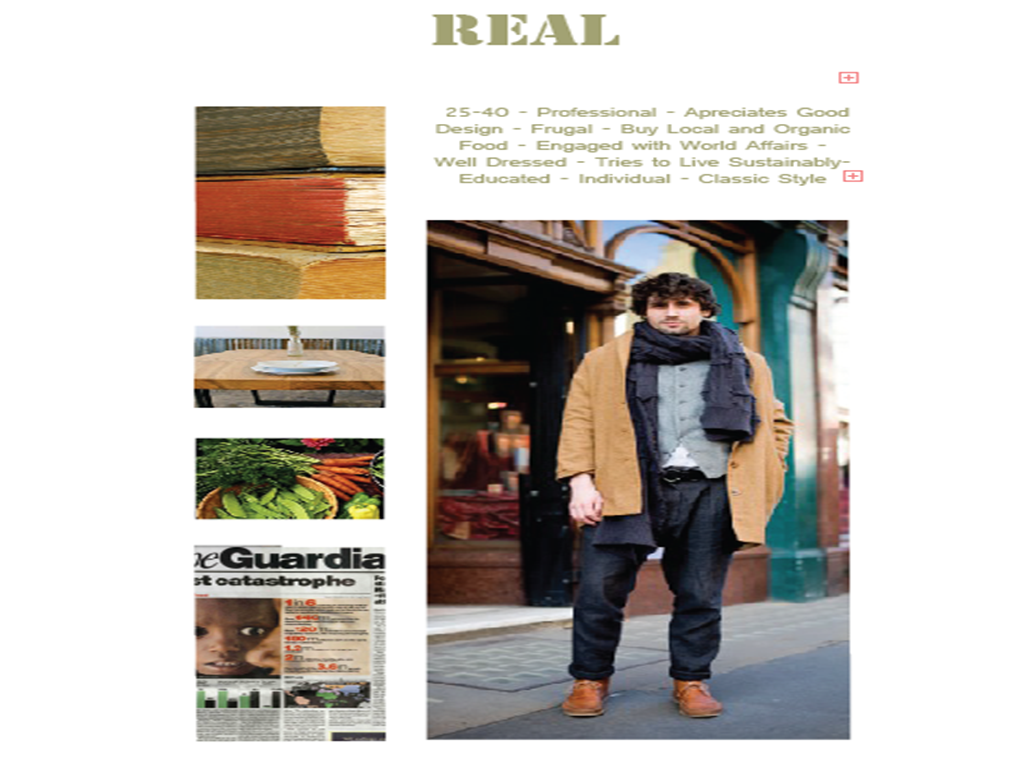
Slow fashion Customer Board


From my research I decided to create a capsule collection of sustainable menswear using high quality, low impact fabrics such as wool and Lyocell to make designs which would out live the fast fashion cycle of one season. I decided to design for my own brand 'Real' which centres around the concept of  educating consumers about how to care for and repair their purchases enabling them to extend the life of their products.


The mood of the collection centres around the idea of creating innovative designs by using traditional techniques, fabrics and styles in new ways. I will look at traditional tailoring techniques and historical features, such as detachable collars, but reinterpret them to create a range of essential pieces with a modern twist.

I'd really appreciate any feedback you have on my ideas so far so please leave a comment below.

Sunday, 31 March 2013

Junky Styling


This semester at university all my work seems to have been very focused on sustainability and designing with an environmental conscience. I think these are important issues for the fashion industry to tackle and I have been very inspired by some of the companies I have researched.
 
A company I came across a while ago but which really stuck in my mind when it came to considering a more sustainable model for the fashion industry is Junky Styling. Operating out of their shop in London this brand's focus is up-cycling and recycling clothing,  creating unique pieces from customers own clothing or second-hand finds.


Junky Styling up-cycled Jacket
http://www.junkystyling.co.uk/

 
As part of my research into the company I read the book produced for its 10 year anniversary, it tracks the evolution of the brand from an inspired idea to a full blown business. It also shows past collections, one of my favourite things about them is the way basic garments such as men's shirts can be remade in to create so many different garments in so many styles. Once you know that the dresses below are made from shirts you can see all the different elements, the collars, buttons and sleeves, but if you didn't know they still look like interesting, classy dresses. 
 
Junky Styling Catwalk
http://sustainablethimble.wordpress.com/tag/recyclable-fashion/ 
 
 
I love the idea that worn out, old clothing can be remade into something new and beautiful; given a whole new life and cherished by someone else. I think the reuse of existing materials, and so the reduction in the use of new raw materials is an important aspect of creating a more environmentally sound fashion industry.


Wednesday, 27 March 2013

Berlin: Wilfried Pletzinger

I've spent the last week traveling around Europe as part of a charity hitchhike, we managed to blag our way to Berlin which is an amazing city full of history, street art and quirky shops. 


Wilfried Pletzinger AW12/13

Wandering around the city we found a little shop called Wilfried Pletzinger selling up-cycled clothes. The focus of the company is customised sportswear, sweatshirts became harem pants while football shirts are made into dresses giving old clothes a new lease of life.


As part of a slow fashion project at university I have been looking into ways garments can be made to last longer, one way of doing this is by reinventing clothes that have become damaged of outdated. Creating something new that can be loved by someone else.


My favourite pieces in the shop were these dresses because of the way they combined bold, bright sportswear with softer fabrics and shapes to create a romantic, feminine garment. I also loved the tops that were made into trousers because of the way they challenged how garments should be worn.


Sustainability in fashion is something I'm really passionate about and seeing up-cycling in practice, being used to make exciting and innovative clothing was really inspiring. It showed that sustainable fashion doesn't have to be about hemp and hippies but can be colourful, fun and interesting.